Learn English for the exam you are actually taking
We analysed the vocabulary that really appears in IELTS, Cambridge and SAT materials, then organised it by goal. Built on the Oxford 3000 and Oxford 5000, from A0 to C1.
Available on iPhone and iPad. The Android app currently covers Finnish only.
Built on the lists English is actually measured by
The Oxford word lists at the core, and the vocabulary real exams keep coming back to around them.
The Oxford 3000 and Oxford 5000
Oxford University Press compiles these with teachers and linguists: words are picked by how often they appear across a corpus of modern English and how useful they are to a learner, then placed on the CEFR scale. The 3000 is the core; the 5000 carries it up to advanced.
Vocabulary from real exam material
Built from published SAT word lists, released test passages, official IELTS sample questions and the Cambridge A2–C1 vocabulary lists, keeping the words that actually recur.
Organised by goal, not by chance
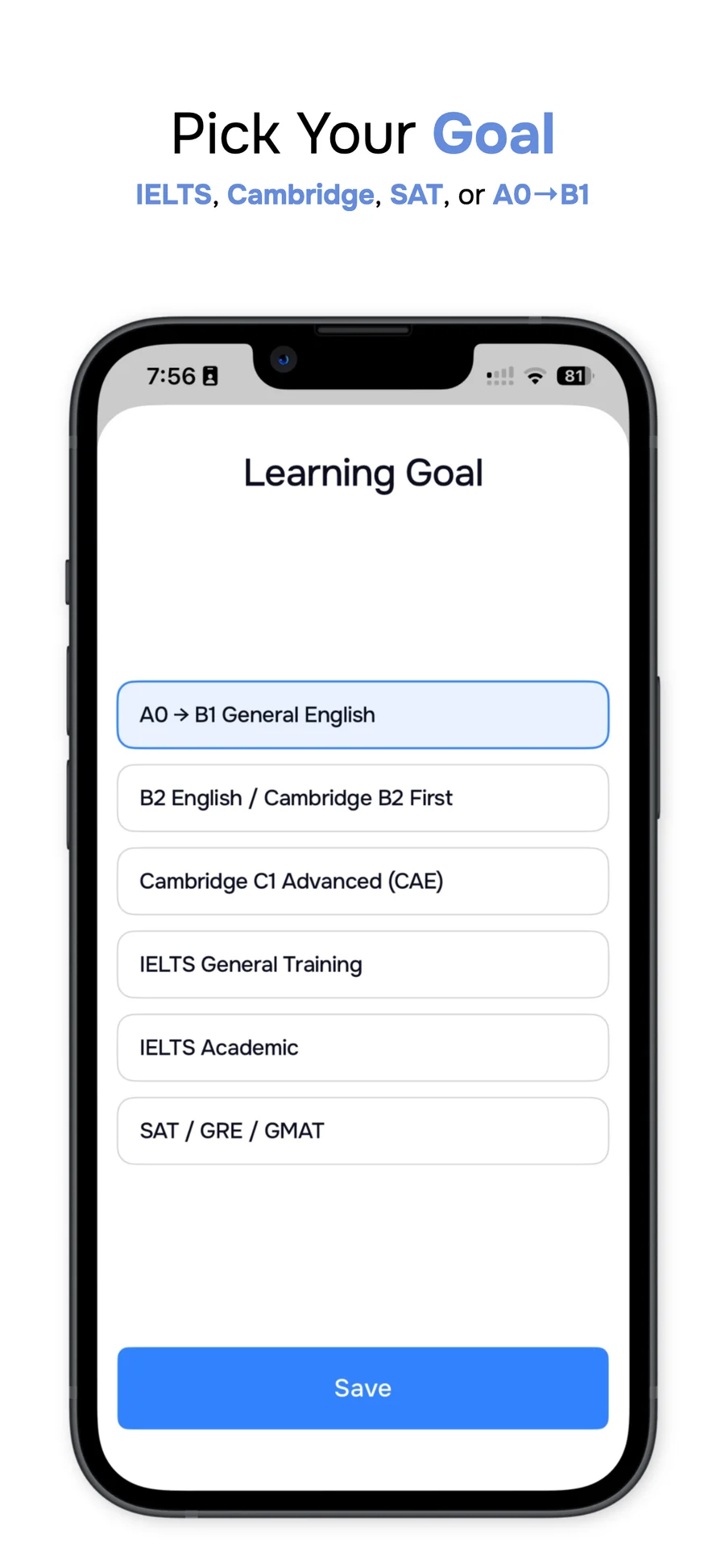
Six paths: A0→B1, Cambridge B2 First, C1 Advanced, IELTS General, IELTS Academic and SAT/GRE/GMAT. Every exam path builds on the general A0→B1 base, so the order is worked out for you.
Learn from 46 languages
From Spanish and Arabic to Bengali, Georgian, Tagalog and Kazakh. Every card is translated into your own language, not explained in English you do not have yet.
Six goals, 61 chapters
Pick the goal that matches your exam. Each one unlocks a defined path.
A0 → B1 General English
2,473 wordsBeginner English (A1)5 chapters · 918
- Greetings & BasicsGreetings, introductions, classroom basics.180
- People & familyFamily, relationships, personal information.174
- Everyday thingsCommon objects, food, clothing, daily items.223
- Places & movementPlaces, getting around, and transport basics.145
- Actions & feelingsEveryday verbs, emotions, simple states.196
Everyday English (A2)5 chapters · 815
- Work & moneyJobs, money, shopping, services.160
- Health & bodyBody parts, health, simple medical talk.196
- Communication & mediaPhones, internet, news, basic media.180
- Society & eventsPublic holidays, events, and community life.114
- Daily routines & habitsSchedules, routines, regular activities.165
Practical English (B1)4 chapters · 740
- Opinions & argumentsExpressing views, agreeing, disagreeing.188
- Education & careerSchool, university, career planning.180
- World & environmentNature, climate, global issues.183
- Abstract & complexAbstract concepts, complex situations.189
B2 English / Cambridge B2 First
1,407 wordsB2 Core Vocabulary5 chapters · 881
- Verbs & actionsB2-level verbs and action vocabulary.179
- People & characterPersonality, character traits, social roles.179
- Work & societyProfessional contexts and social structures.174
- Science & technologyTech topics, scientific concepts.178
- Abstract ideas & opinionAbstract thought, expressing opinions.171
B2 Advanced & Skills3 chapters · 526
- Arts & cultureArt, music, literature, cultural life.175
- Word formation & collocationsPrefixes, suffixes, common collocations.175
- Linking & discourseConnectors, signposting, discourse markers.176
Cambridge C1 Advanced (CAE)
1,246 wordsC1 Core Vocabulary4 chapters · 712
- Abstract reasoning & nuanceSubtle distinctions, abstract reasoning.176
- Formal & professional registerFormal writing, business and academic register.179
- Social & political discourseSociety, politics, public debate.176
- Science, technology & researchAdvanced scientific and research vocabulary.181
C1 Advanced Topics3 chapters · 534
- Arts, culture & literatureCultural criticism, literary analysis.180
- Debate, opinion & evaluationPersuasive language, argumentation, evaluation.176
- Specialized & Less Common VocabularySpecialized and lower-frequency vocabulary.178
IELTS General Training
496 wordsPractical Life & Work2 chapters · 248
- Everyday & workplace vocabularyDaily life and workplace situations.123
- Formal communication & requestsLetters, requests, formal exchanges.125
IELTS General Skills2 chapters · 248
- Common phrases & expressionsUseful phrases for IELTS General context.124
- Reading & writing vocabularyVocabulary for reading and writing tasks.124
IELTS Academic
1,552 wordsIELTS Academic Core6 chapters · 676
- Research methods & dataResearch vocabulary, methodology, data analysis.224
- Charts, trends & proportionsDescribing graphs, trends, statistical relationships.90
- Analysis & evaluationAnalyzing, evaluating, comparing ideas.90
- Academic argument & structureBuilding arguments, essay structure.92
- Academic collocations & phrasesCommon academic word combinations.89
- Hedging, linking & discourseHedging language, discourse markers, formality.91
Academic Subject Vocabulary7 chapters · 876
- Education & societyEducation systems, social issues.91
- Science & technologyScientific concepts, technological change.89
- Environment & ecologyEnvironmental issues, climate, conservation.91
- Health & lifestylePublic health, lifestyle, wellbeing.152
- Economy, work & globalizationEconomic concepts, labor, globalization.151
- History, culture & mediaHistorical and cultural themes, media studies.151
- Mixed academic vocabularyBroad academic vocabulary across topics.151
SAT / GRE / GMAT
2,451 wordsSAT Reading Vocabulary6 chapters · 1,047
- Character & behaviorPersonality, conduct, traits.223
- Argument & persuasionLogical argument, rhetoric, persuasion.181
- Abstract qualitiesAbstract qualities and attributes.170
- Actions & processesVerbs of action and process.156
- Relationships & conflictHuman relationships, conflict, resolution.158
- Knowledge & communicationKnowledge, learning, communication.159
Exam Passage Vocabulary6 chapters · 937
- Science & natureScience passage vocabulary: nature, biology.153
- History & societyHistorical and societal passage vocabulary.152
- Technology & mathematicsTech and quantitative passage vocabulary.156
- Literature & the artsLiterary and arts passage vocabulary.155
- Politics & governmentPolitical and civic passage vocabulary.160
- Mixed passage vocabularyMixed-topic exam passage vocabulary.161
Foundation Vocabulary Review3 chapters · 467
- Foundation Review 1First review set of foundational SAT/GRE vocabulary.161
- Foundation Review 2Second review set of foundational SAT/GRE vocabulary.151
- Foundation Review 3Third review set of foundational SAT/GRE vocabulary.155
Real cards from the deck
Actual vocabulary as it appears in the app.
We have a fun activity today.
He's an actor.
She is an actress and travels a lot.
He's an adult now.
Participants were actively recruited through online surveys and university mailing lists.
A loud bang was recorded during the trial, which may have compromised the data.
Outliers were excluded from the analysis to reduce distortion in the final results.
Two abnormal values were excluded.
Learn English from 46 languages
Including the ones most apps ignore. Every card is fully translated.
- Swedish
- Russian
- Arabic
- Finnish
- Hebrew
- Spanish
- Greek
- French
- German
- Italian
- Portuguese
- Dutch
- Polish
- Latvian
- Estonian
- Lithuanian
- Chinese
- Hindi
- Japanese
- Korean
- Urdu
- Turkish
- Vietnamese
- Persian
- Ukrainian
- Albanian
- Norwegian
- Danish
- Indonesian
- Bangla
- Thai
- Punjabi
- Filipino
- Malay
- Tamil
- Telugu
- Romanian
- Czech
- Hungarian
- Bulgarian
- Serbian
- Croatian
- Slovak
- Uzbek
- Kazakh
- Georgian
Common questions
Which exams does Pecto prepare me for?
IELTS Academic and General, Cambridge B2 First and C1 Advanced, and SAT/GRE/GMAT. Each is a separate goal with its own vocabulary path, plus a general A0→B1 track if you are starting out.
What are the Oxford 3000 and Oxford 5000?
Two word lists published by Oxford University Press and compiled with teachers and linguists. Words earn their place by how often they turn up across a corpus of modern English and how useful they are to a learner, and each one is tagged with a CEFR level. The 3000 covers the core of the language; the 5000 adds what you need at B2–C1.
What languages can I learn English from?
46, including Spanish, Arabic, Hindi, Chinese, Bengali, Tagalog, Georgian and Kazakh. Cards are translated into your language rather than explained in simplified English.
Do I need to be online?
No. Download a chapter once and both the cards and the audio work offline.